


Small BAy, Big Thinking
Most industrial developers are chasing a product type that’s oversupplied. The real opportunity is in small bay — and it’s been hiding in plain sight.
- INDUSTRIAL TRENDS
Why Bigger Stopped being better
For the better part of a decade, industrial real estate chased one metric above all others: size. Bigger clear heights. Bigger footprints. Bigger logistics deals. The race to build half-million-square-foot distribution centers defined the cycle, and for a while, the math worked.
It doesn’t anymore. The same capital that funded the big-box boom is now sitting on 7–9% vacancy in many markets while the building type next door hasn’t cracked 4%. Pandemic-era supply came online just as demand softened. Small bay, meanwhile, sits near historic lows — under 4% nationally, sub-3% in some corridors of the Sun Belt region. The numbers below tell the story. Most institutional capital is still chasing the product type that’s oversupplied.
<4%
National vacancy rate for small bay industrial (under 50,000 SF)
Source: Cushman & Wakefield Industrial MarketBeat Q1 2025
7-9%+
Vacancy rate for large-format industrial (250,000+ SF) in many markets
Source: PwC/ULI Emerging Trends in Real Estate 2026
<0.3%
New small bay construction as a share of existing stock nationally
Source: CoreBridge Financial CREI Market Insights – June 2025
87%
Of all lease deals in Atlanta Q1 2024 were for buildings under 50,000 SF — consistent with similar trends across Houston, Dallas, and Charlotte
Source: CompStak / Small Bay Industrial Trend Report 2025
Why Now: Four Forces Converging in 2026
Small bay industrial has existed for decades. What’s changed isn’t the product type — it’s the intensity of demand now converging from four directions at once.
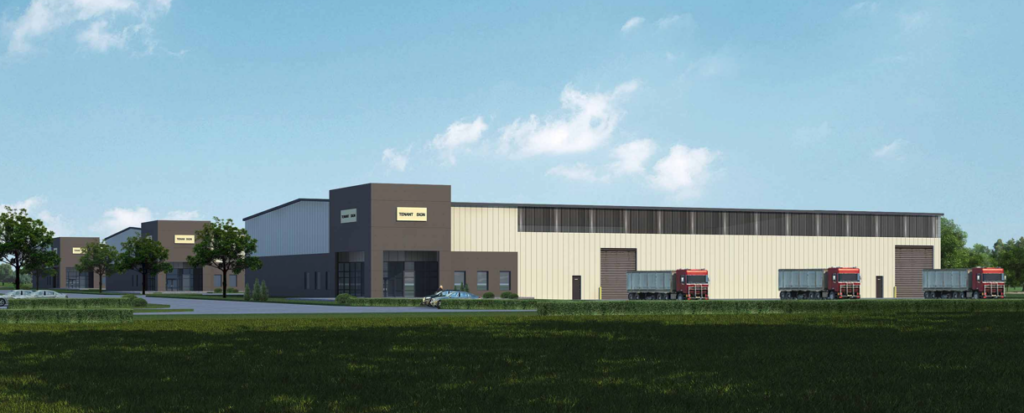
- Tariffs, Reshoring, and the Return of American Manufacturing
Trade policy has made offshoring less attractive and manufacturing is gaining momentum — now accounting for 20% of new industrial leasing in the Southeast and Central U.S., up from 13% pre-pandemic. The real story isn’t the Fortune 500 headlines. It’s the thousands of smaller manufacturers and fabricators that make up 98% of all U.S. manufacturing companies. They’re coming back, and they need modest, flexible footprints close to customers and suppliers. - Section 179 and the Equipment Investment Wave
The One Big Beautiful Bill Act expanded Section 179 expensing, allowing small manufacturers to fully deduct large equipment purchases in the year of acquisition — CNC machines, welding systems, fabrication equipment, specialty tooling. The equipment investment follows the tax incentive. The space to put it in follows the equipment. - Aging Inventory That Can’t Keep Up
Much of the existing small bay stock was built in the 1980s and 1990s. These buildings routinely lack the power infrastructure, data connectivity, clear height, and operational layout that today’s tenants require. New purpose-built product isn’t competing against modern alternatives — it’s replacing obsolete stock the market has been tolerating for years. - The Tenant Pool Is Enormous
98% of U.S. manufacturing companies are classified as small businesses. Add trade contractors, food and beverage packagers, showroom-warehouse operators, and last-mile logistics users — and the addressable tenant base dwarfs what any single big-box building can accommodate. That’s not a weakness. It’s a vacancy hedge.
KEY DEMAND DRIVERS AT A GLANCE | Small bay vacancy under 4% nationally — sub-3% in top Sun Belt markets |
|---|
Section 179 expensing: small manufacturers deducting equipment costs, then needing space for it |
Manufacturing now 20% of new industrial leasing in SE/Central US — up from 13% pre-pandemic |
50%+ of existing small bay stock built pre-1990 — obsolete power, data, and layout |
98% of U.S. manufacturers are small businesses — the addressable tenant pool is enormous |
Who's in These buildings
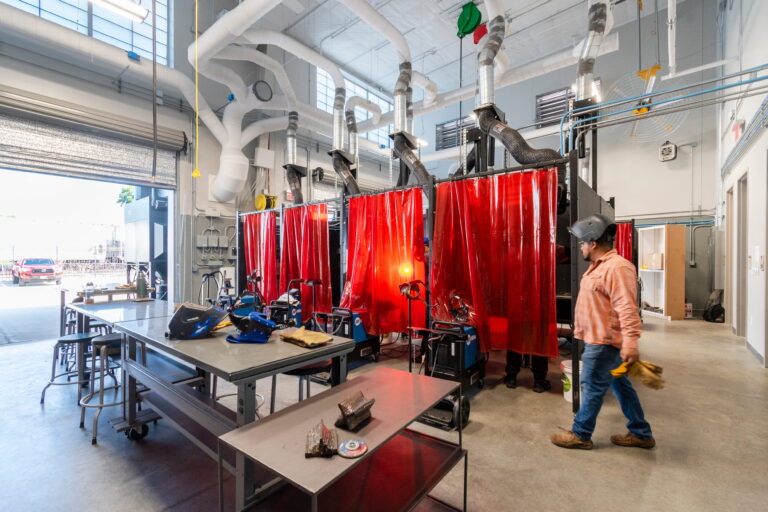
Small bay attracts a fundamentally different tenant profile than bulk distribution. These users don’t need 130-foot loading courts and cross-dock configurations. They need practical, well-located space with the right power, grade-level access, and room to make it their own. The table below captures the primary tenant types and the key design requirement for each.
TENANT TYPE | TYPICAL SF | KEY DESIGN NEED |
|---|---|---|
Light Manufacturers & Fabricators | 10,000-25,000 SF | Crane-ready structure, heavy power, grade-level loading, laydown yard |
Trade Contractors | 5,000–15,000 SF | Grade-level doors, yard storage, easy vehicle access, flexible office |
Machine & Welding Shops | 8,000–20,000 SF | 480V 3-phase, crane-ready, ventilation, sealed slab |
Food & Beverage Packaging | 10,000–25,000 SF | Dock option, floor drains, enhanced utilities, climate consideration |
Showroom / Warehouse Combo | 5,000–15,000 SF | Corner wrap entry, glazing at office, front parking, grade-level access |
Specialty E-Commerce / Last Mile | 5,000–12,000 SF | Grade-level loading, data/fiber, flexible floor plan, proximity to density |
Auto, Custom Fab & Creative Users | 5,000–15,000 SF | Oversized grade-level doors, flexible utilities, yard access |
The Design Playbook
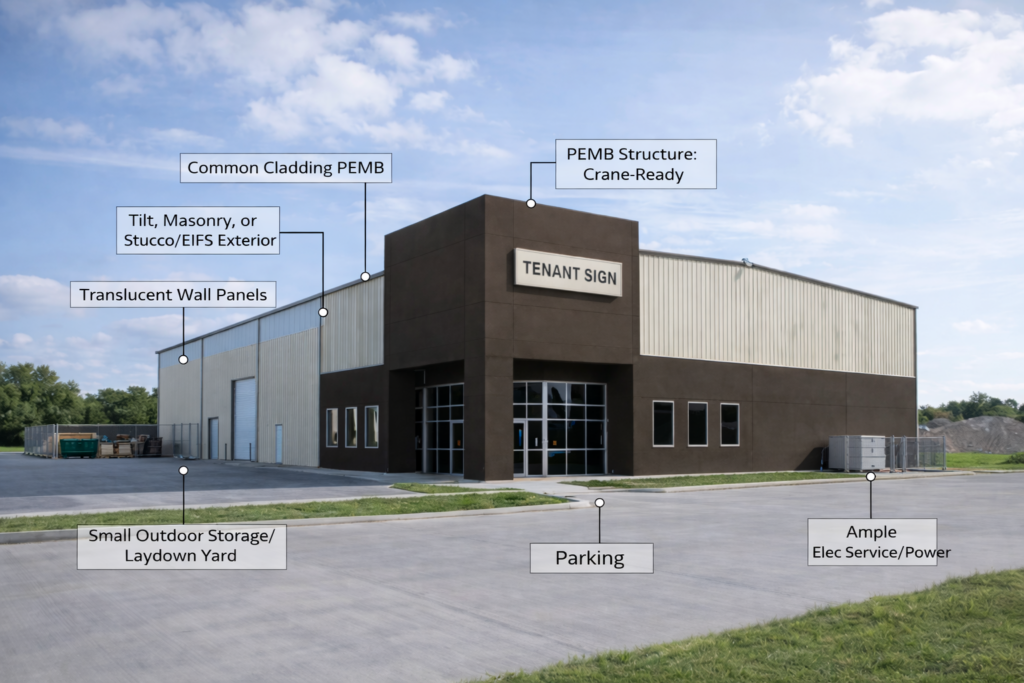
This is where most market commentary stops — at the macro opportunity — and where Method starts. Small bay design is deceptively nuanced. Get the specs wrong and you’ll lease slowly and re-tenant expensively. The table below reflects what’s working in the market right now.
SPECIFICATION | SWEET SPOT |
|---|---|
Total Building Size | 15,000–30,000 SF per building |
Building Depth | 80–140 feet |
Bay Spacing | 25 feet on center |
Clear Height | 20–28 feet (varies by tenant profile and market) |
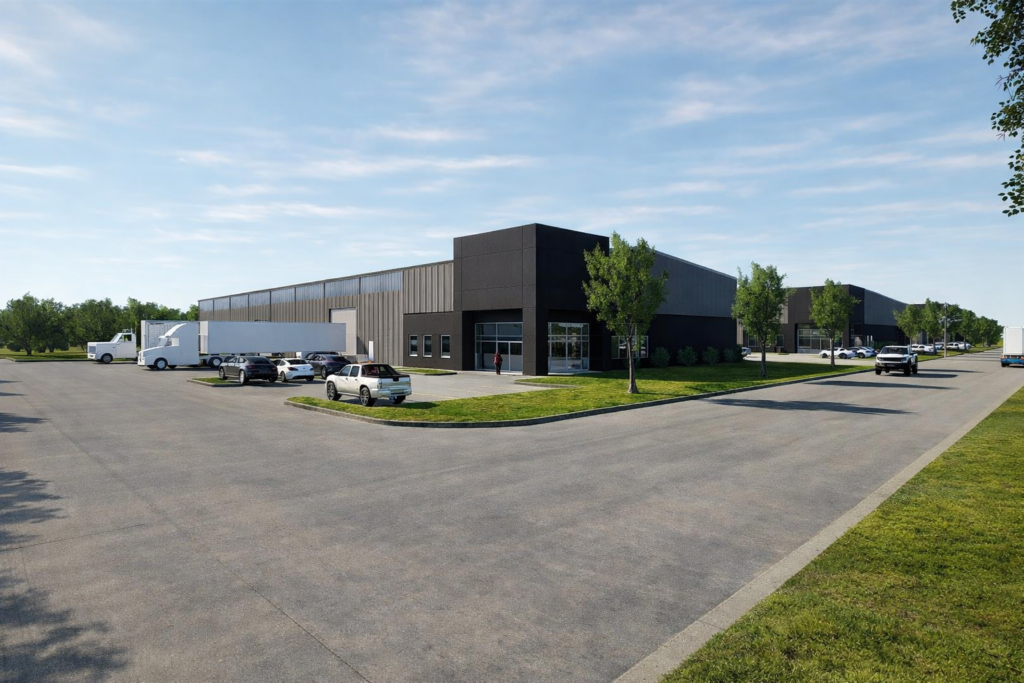
Structure | PEMB frame with metal skin; hybrid tilt-wall or masonry at entry |
Loading | Grade-level as standard; single dock option available |
Office Buildout | 1,500–2,500 SF spec — restroom/ready, open plan for tenant customization |
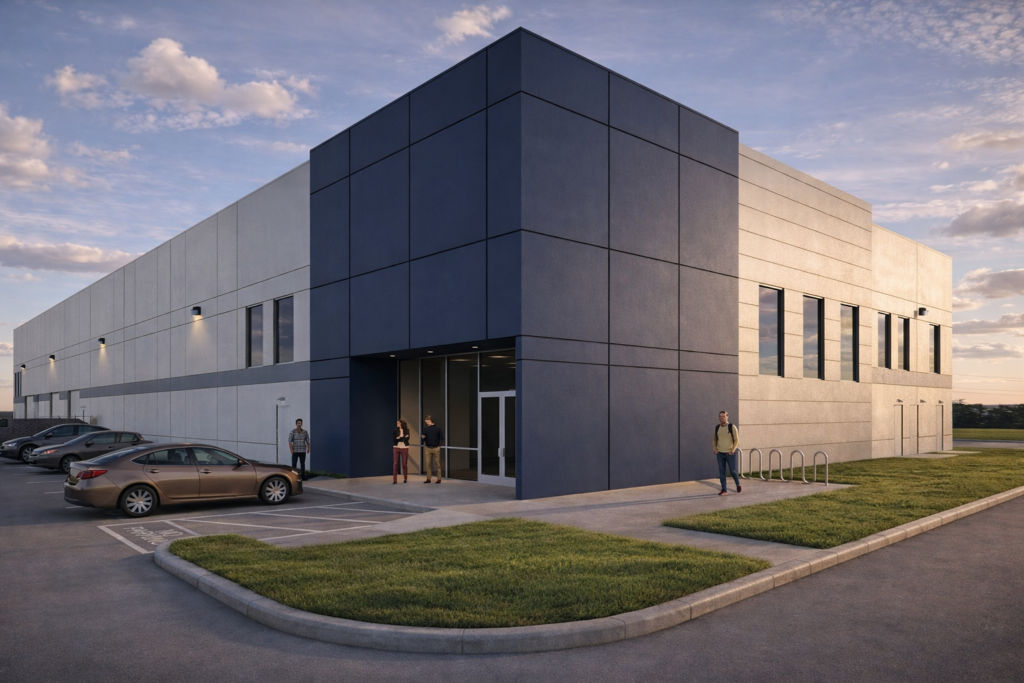
Entry Feature | Corner wrap entry with glazing — curb appeal matters at this scale |
Crane Ready | 10–20 ton capacity, 20′ hook height; structure and bay spacing designed in — crane procured by tenant at occupancy |
End Walls | Expandable — designed from day one for future bay additions |
Outdoor Storage | Laydown yard/outside storage included as standard |
Power | 480V 3-phase, 600–800A minimum per building; expandable capacity at panel |
Data / Fiber | Conduit infrastructure spec’d in — tenant selects provider at occupancy |
Park Configuration | 5–10 buildings; individual parcels sized for separate sale or portfolio hold |
A NOTE ON POWER
AMPING UP CAPACITY
Source: Capstone Commercial Real Estate; Industrial Property Loan, 2025
The Campus Model
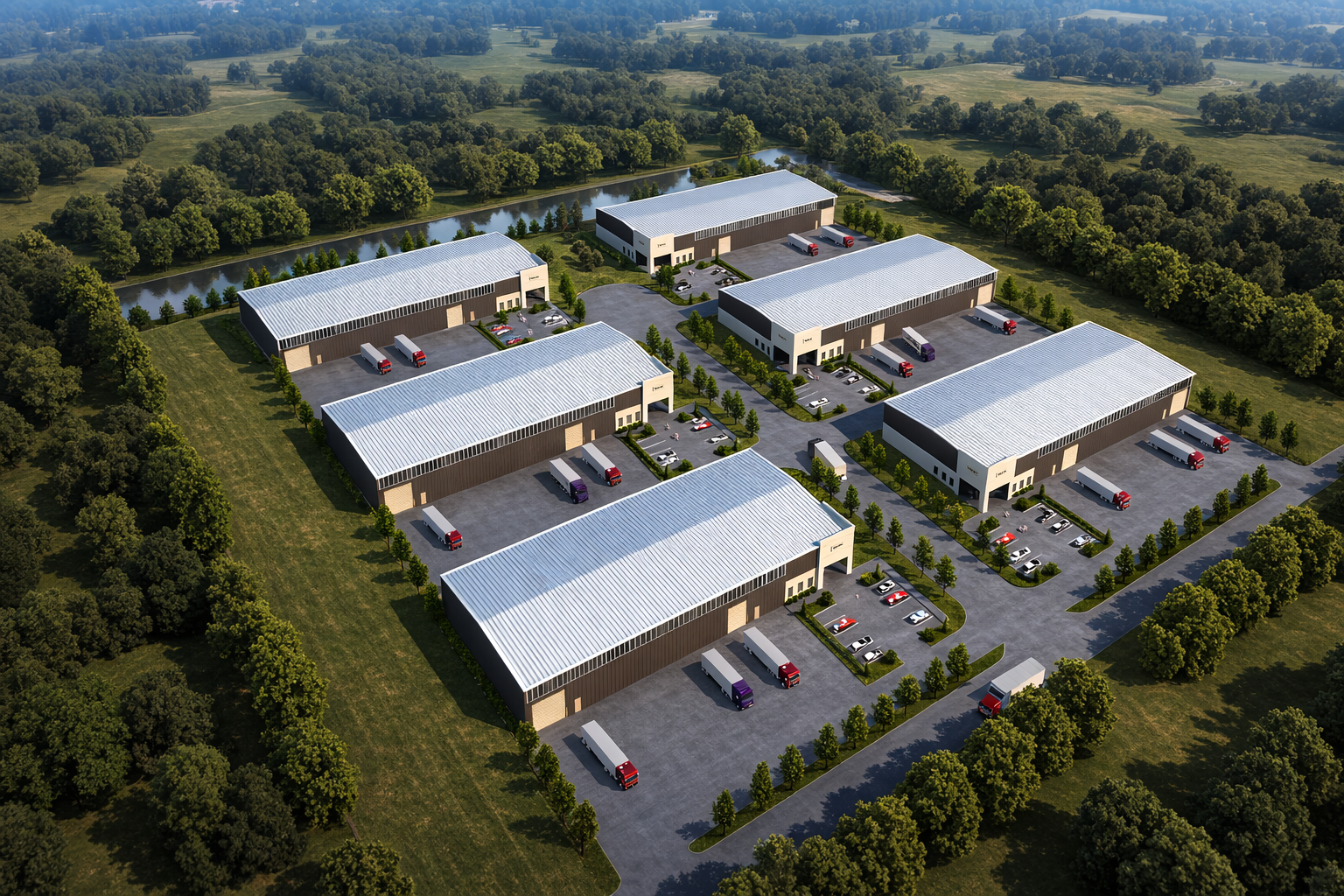
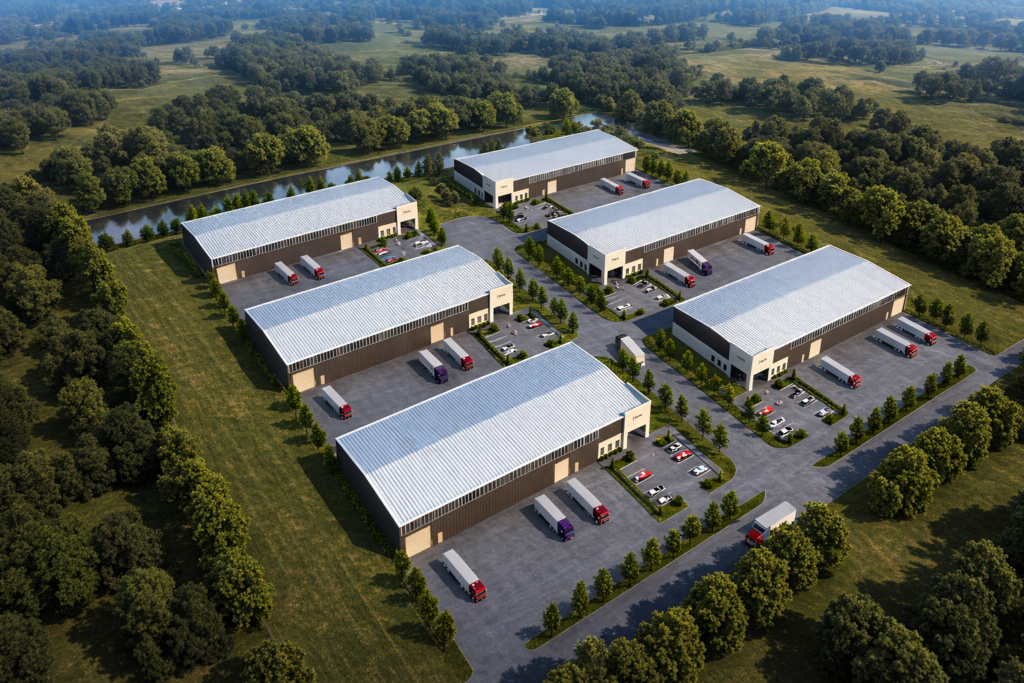
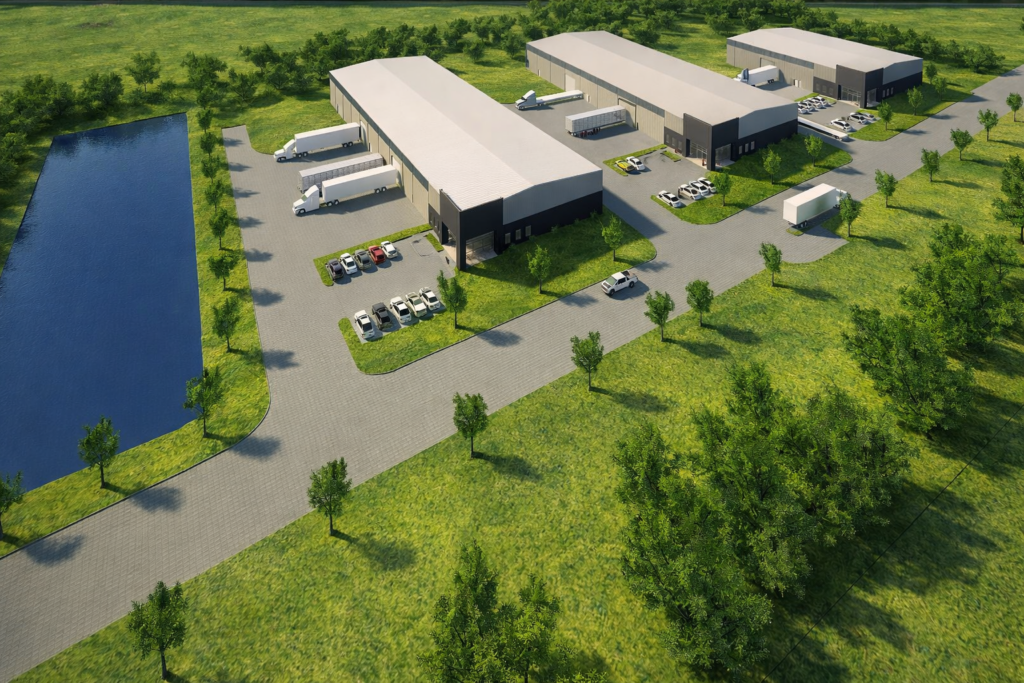
Small bay is rarely a single building play. The most effective format is the mini business park: 5–10 buildings on a shared circulation spine, with individual parcels designed to be sold separately or held as a portfolio. This gives developers real exit flexibility — lease and hold, sell to owner-occupants, or package for portfolio sale.
The condo and parcel sale model has gained significant traction in Texas and Sun Belt markets as small business owners seek equity rather than indefinite leasing. Get the master plan right early — traffic flow, fire access, shared detention, utility easements — and individual building permitting follows cleanly from there.
Campus Design Considerations
- Shared circulation spine with clear truck/auto separation
- Fire access roads serving all buildings (typically 20′ wide, all-weather)
- Outdoor storage/laydown yards per building — not shared across parcels
- Individual utility meters per parcel for clean condo/individual sale
- Detention/drainage resolved at master plan level
- Expandable end walls aligned across buildings for phased addition
Making the Numbers Work
Institutional capital has been slow to embrace small bay — smaller per-building returns, tighter debt markets, longer hold periods. These are real friction points. But the risk profile tells a different story. Sub-4% vacancy means fast absorption and low re-leasing exposure. Shorter lease terms (1–5 years vs. 7–10 for big-box) allow more frequent rent resets in a market where small bay rent growth is outpacing bulk industrial. Lower TI per tenant and a diversified roster reduce the single-tenant concentration risk that makes big-box painful when demand softens.
The TI math also favors small bay. A typical small bay tenant buildout runs $15–40/SF — mostly demising walls, restroom finish, and minor MEP connections. Big-box distribution finish-out for a sophisticated user can run $60–100/SF or more once you factor in dock equipment, automation rough-in, and specialty power. Lower per-tenant TI exposure spread across a diversified roster is a fundamentally different risk profile. The individual parcel/condo sale model adds an exit lever that big-box simply doesn’t have. Owner-occupant buyers in Texas and Sun Belt markets (Southern California, Southern Nevada, Arizona, New Mexico, Texas, Louisiana, Alabama, Mississippi, Georgia, and Florida) regularly pay premiums above replacement cost — because for a small business owner, buying your building is a balance sheet move, not just a real estate one.
THE DEVELOPER’S ADVANTAGE | Sub-4% vacancy = fast absorption, low re-leasing risk |
|---|
Short lease terms (1–5 yr) allow faster rent resets in a rising market |
Small bay rent growth outpacing bulk industrial (CompStak, 2025) |
Lower TI per tenant vs. big-box distribution users |
Diversified tenant base hedges against single-tenant vacancy risk |
Individual parcel/condo sale model — an exit lever big-box does not have |
Federal tax incentives actively driving tenant demand for new product |
Getting the Region Right
Small bay is a national opportunity, but a one-size-fits-all spec is a leasing liability. The design decisions that produce a 95% leased project in Houston are not the same ones that work in Charlotte or Chicago.
TEXAS | SOUTHEAST | MIDWEST |
|---|---|---|
Strong condo/owner-occupant demand. Outside storage critical. PEMB/tilt-wall hybrid dominant. High growth in Houston, DFW, and Austin. | Manufacturing tenant base growing fastest. Crane-ready increasingly standard. Strong absorption in GA, NC, SC, and TN. | Workforce proximity drives site selection. Deeper mix of trade, assembly, and distribution users. Chicago, Columbus, and Indianapolis lead activity. |
Method Architecture operates across Texas and is licensed in 28 states nationwide. Regional fluency is not a nice-to-have. It is the difference between a project that performs and one that struggles.
The outlook: Built for this moment
New industrial supply is at historic lows. Big-box construction starts fell sharply through 2025 as capital markets tightened and replacement costs ran approximately 20% above achievable market rents, making new speculative development difficult to underwrite. Small bay operates under fundamentally different economics — lower land costs, smaller capital requirements, faster lease-up, and stronger relative pricing power against aging stock.
The NAIOP Research Foundation projects reshoring alone could expand the U.S. manufacturing base by 6–13% over the next decade. Based on current space-per-worker ratios, that translates to hundreds of millions of square feet of new industrial demand — much of it in the 15,000–50,000 SF range where small bay operates. The developers who build well-designed, right-sized small bay product over the next 24–36 months are positioning for a demand surge the market is structurally unprepared to meet.
The buildings that perform will be the ones designed with intention — not the ones that treat small bay as a scaled-down version of something bigger. The window is open. The question is which developers will move while institutional capital is still looking the other way.
Sources
- Cushman & Wakefield Industrial MarketBeat Q1 2025
- PwC/ULI Emerging Trends in Real Estate 2026
- CompStak / Small Bay Industrial Trend Report 2025
- CoreBridge Financial – Small Bay Big Play
- NAIOP Research Foundation — Manufacturing Growth and Its Effects on North American Industrial Markets
- JLL — Adapting to Shifting Trade Policies: 5 Key Predictions for Industrial Real Estate, 2025
- Capstone Commercial Real Estate; Industrial Property Loan — Power infrastructure benchmarks, 2025
- CRE Daily / Bisnow — Apple, Nvidia, Johnson & Johnson U.S. manufacturing investment announcements, 2025–2026
- Method Architecture / ConnectCRE — Micro-Flex Industrial: Small Bay Industrial Comes Into Its Own, 2025
- WareCRE — Small Bay Industrial Guide: An In-Depth Look at the Underdog of Industrial Real Estate, October 2025