


Built to Plug In
Designing Industrial Facilities for the Automation Era
As automation, reshoring, and rising power demands transform industrial real estate, the next generation of tenants isn’t just looking for warehouse space—they’re looking for buildings ready to support robotics, AI-driven operations, and advanced logistics from day one.
- INDUSTRIAL DESIGN TRENDS
Designing Industrial buildings for the automation era
Manufacturing is coming home. Warehouses are automating. Power demand is surging. But the vast majority of existing industrial inventory was designed for a different era—manual labor, standard racking, basic electrical service.
The next generation of tenants doesn’t just want space. They want a platform they can deploy on. This article examines where industrial facilities are headed, why today’s spec shells aren’t ready, and what developers can do at the shell stage—without over-building or over-spending—to deliver buildings that let automation plug in from Day 1.
The key isn’t installing tenant equipment in a spec building. It’s making sure nothing about the shell gets in the way when they do.
TERM | WHAT IT MEANS |
|---|---|
AMR | Autonomous Mobile Robot — self-navigating bots that move goods without fixed tracks |
AS/RS | Automated Storage & Retrieval System — robotic systems that store and pull inventory vertically |
BESS | Battery Energy Storage System — on-site battery banks that store and dispatch power during peak demand |
CBRS | Citizens Broadband Radio Service — the spectrum used for private 5G networks in industrial facilities |
ELO | Extra Large Orifice — a control-mode sprinkler with a larger orifice (K11.2+) used in storage occupancies, less robust than ESFR |
ESFR | Early Suppression Fast Response — high-performance sprinkler systems designed for high-piled storage |
FF/FL | Floor Flatness / Floor Levelness — measurable standards for slab quality (critical for robotics) |
IDF | Intermediate Distribution Frame — network closets that distribute data/connectivity throughout the building |
MDF | Main Distribution Frame — the primary network hub where external data lines enter the building |
NFPA | National Fire Protection Association — the organization that publishes fire and life safety codes (e.g., NFPA 13) |
SKU | Stock Keeping Unit — a unique identifier for each product in a warehouse inventory system |
SMR | Small Modular Reactor — next-generation nuclear power units being developed for industrial-scale on-site generation |
TI | Tenant Improvement — the buildout a tenant does to customize their space after the shell is delivered |
VNA | Very Narrow Aisle — tight racking layouts (often wire- or laser-guided) that maximize storage density |
WCS | Warehouse Control System — software that directs and coordinates automated equipment (conveyors, sorters, AMRs) in real time |
The Building After the Human
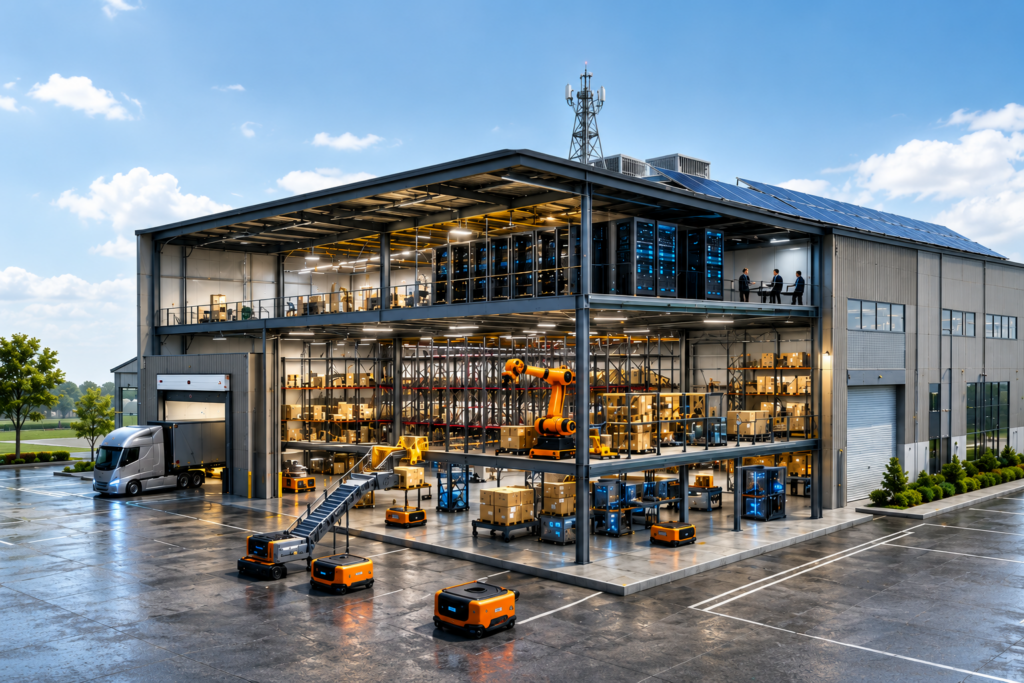
It’s 2 AM on a Tuesday in southeast Texas. The air is still thick from an evening thunderstorm, and the smell of wet concrete and wildflowers hangs over the industrial park. The day shift went home hours ago—but the building didn’t.
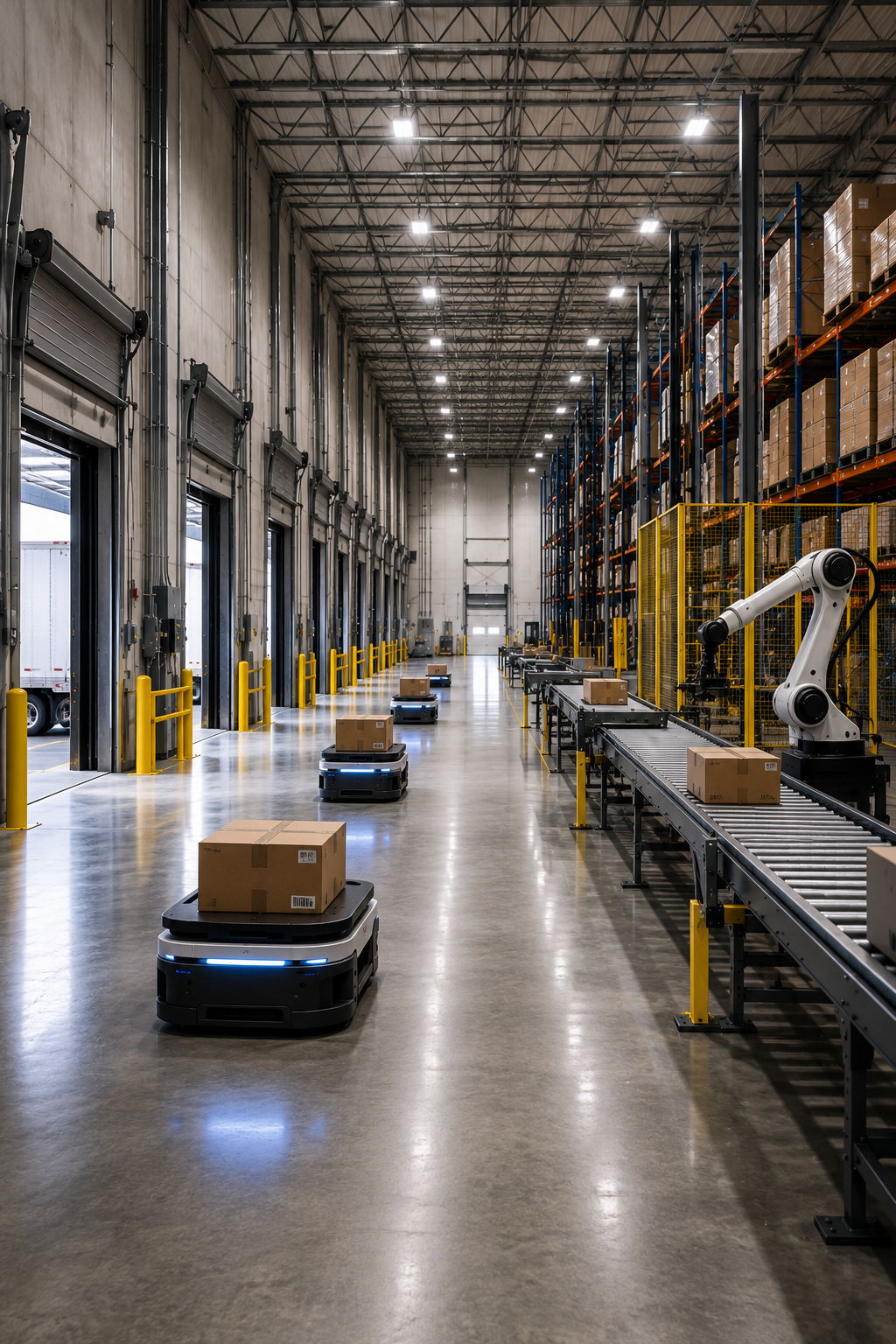
Inside a 200,000-square-foot facility at the edge of the park, the overnight work is running itself. An electric eighteen-wheeler—guided by autonomous driving systems already in commercial testing—pulls into a loading court engineered to the inch. The building’s control network registered the truck a mile out, verified the manifest, and opened the dock door before it arrived. A charging arm extends to the cab while a fleet of Autonomous Mobile Robots (AMRs) begins unloading pallets, scanning stock keeping units (SKUs), and routing inventory through vertical conveyors that reach eighty feet into the clear height above.
On the roof, a private 5G antenna coordinates every robot on the floor. Solar panels feed a battery energy storage system (BESS) that supplements grid power during peak demand—no small thing in a Texas summer. The HVAC system is calibrated not just for the team that returns at 6 AM, but for the heat loads generated by lithium-ion charging stations and compute nodes running inventory optimization in real time.
At a drone launch pad on the building’s yard, the first outbound local deliveries of the morning lift off into a dark, humid sky.
By sunrise, inventory is sorted, outbound shipments are staged—and the first employees of the day walk into a facility that’s already done six hours of work. They’re not here to move boxes. They’re here to manage systems, oversee quality, and make the decisions that machines can’t. The building handled the heavy lifting—literally—while they slept.
This may sound like a logistics pitch deck. It isn’t. Every technology described above exists today—autonomous trucks are in commercial testing, AMR fleets operate in thousands of facilities worldwide, private 5G networks are live, and Small Modular Reactors (SMRs) are in the U.S. Department of Energy (DOE) licensing pipeline. Automation isn’t replacing the workforce. It’s extending what the workforce can do—and it’s the reason domestic manufacturing is becoming competitive again. The question is no longer whether this future arrives. It’s whether the buildings we’re permitting today will be ready for it when it does.
That Future is Closer Than You Think
Three structural forces are converging on the same loading dock—and they’re moving faster than most developers’ design assumptions.
Reshoring
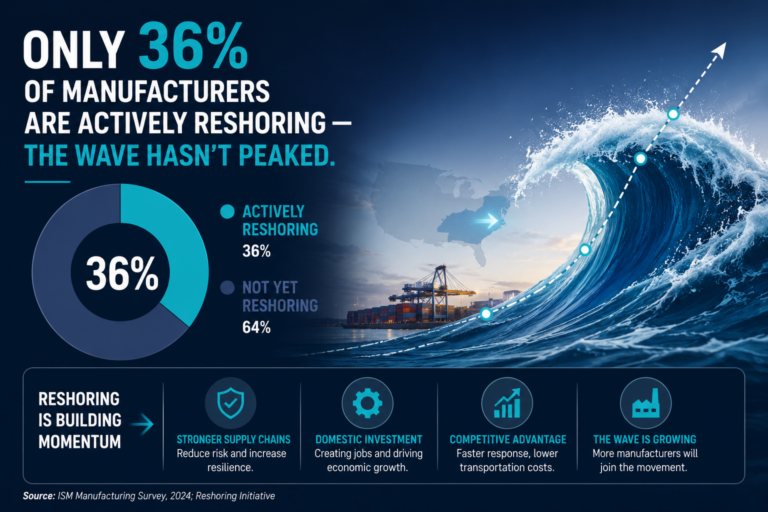
Tariff policy, the CHIPS and Science Act’s $53 billion in semiconductor manufacturing incentives, and post-pandemic supply chain recalibration are pulling manufacturing back to U.S. soil. But only 36% of manufacturers are actively pursuing reshoring strategies so far—meaning the demand wave hasn’t peaked. And 98% of U.S. manufacturers are classified as small businesses, which means the space they need isn’t 500,000-square-foot distribution centers. It’s 15,000–80,000 SF flex and light industrial—the exact product type with the tightest vacancy in most markets.
Automation
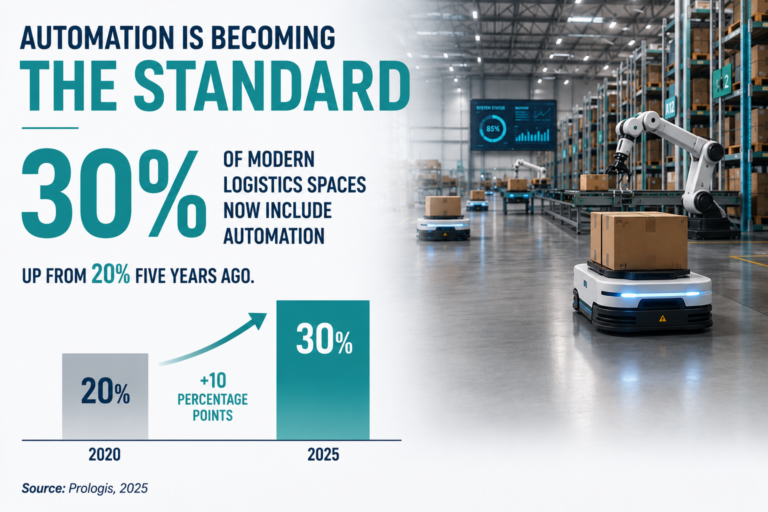
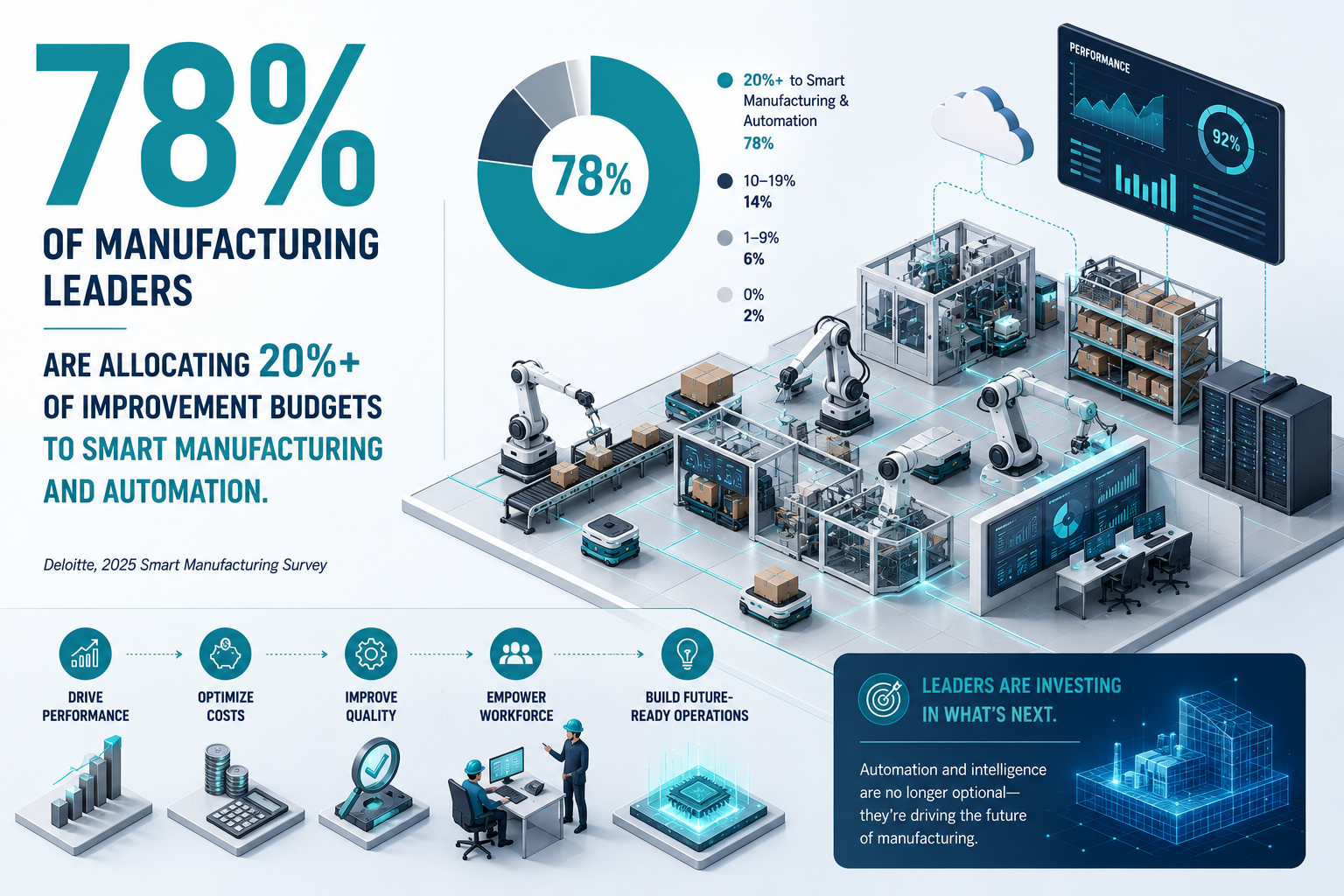
Thirty percent of modern logistics spaces now incorporate at least one form of automation, up from roughly 20% five years ago. The warehouse automation market is valued at approximately $30 billion in 2025 and is projected to exceed $65 billion by 2031, growing at a compound annual growth rate (CAGR) of nearly 14%. Tenants are arriving with AMR fleets, Automated Storage and Retrieval System (AS/RS) specifications, conveyance and sortation layouts, warehouse control systems (WCS), and go-live timelines that don’t leave room for construction surprises. These aren’t isolated pieces of equipment—they’re integrated systems, increasingly orchestrated by artificial intelligence (AI) and machine learning that optimize everything from pick paths to energy consumption in real time. Meanwhile, 78% of manufacturing leaders surveyed by Deloitte report allocating more than 20% of their improvement budgets toward smart manufacturing initiatives—including automation hardware, sensors, and AI.
Power
Electrical capacity has quietly become a top-three site selection criterion. Between automation loads, electric vehicle (EV) fleet charging, battery systems, and data-driven operations, tenants are evaluating amps before square footage. An AS/RS system changes the building’s entire power profile. And the grid isn’t keeping up—utilities are increasingly reluctant to deliver full capacity to a spec shell without a committed user, creating a chicken-and-egg problem that forward-thinking developers are solving at the design stage.
"The tenant touring your building today arrives with robots, conveyor specs, and an electrician. If your building can't plug them in, they're moving on to one that can."
The Gap - Why Many of Today's Shells aren't ready
The standard developer playbook has worked for decades: build a clean spec shell, let the tenant customize. And for traditional warehouse and distribution users, it still works fine. But when the tenant’s equipment list includes autonomous robots that need superflat floors, a fiber backbone for real-time coordination, and dual-voltage distribution for a charging fleet—the “clean shell” becomes a renovation project before they’ve moved a single pallet.
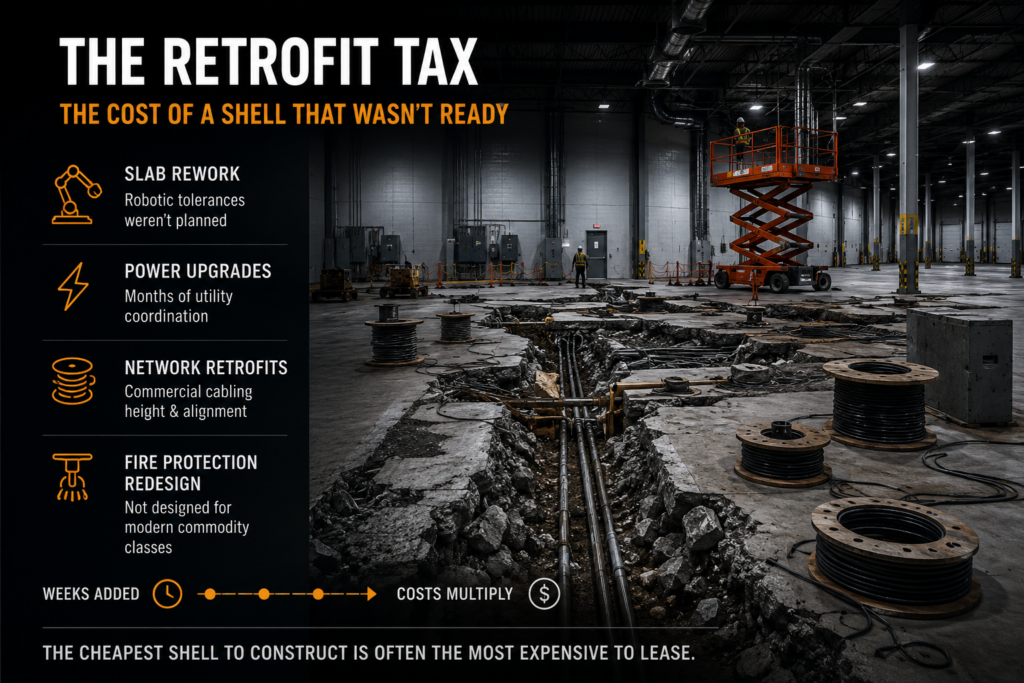
This is the retrofit tax—the hidden cost that shows up when a building designed for conventional use meets a tenant with automation requirements. It’s not a knock on current design practices. It’s a recognition that the tenant profile is changing, and the spec shell hasn’t always kept pace. The retrofit tax shows up in predictable ways:
- Slab rework. Very Narrow Aisle (VNA) racking and Automated Storage and Retrieval System (AS/RS) corridors require superflat floor tolerances well beyond standard Floor Flatness/Floor Levelness (FF/FL) specs. If the joints are in the wrong place, the fix is saw-cutting and repouring—weeks of delay and significant cost before a single rack goes up.
- Power upgrades. When the duct bank and switchgear were sized for today’s load and not tomorrow’s, adding capacity means months of utility coordination, new transformer pads, and potentially re-trenching the site.
- Network retrofit. Running fiber, conduit, and network infrastructure after the shell is complete means exposed pathways, compromised ceiling height, and change orders that compound through the project.
- Fire protection gaps. Most new industrial shells are designed with Early Suppression Fast Response (ESFR) sprinkler systems—the current standard for high-piled storage. But ESFR design parameters under NFPA 13 are commodity-class-specific. A system designed for Class I–IV commodities may not be adequate if a tenant’s operation shifts to Group A plastics or high-density automated storage configurations. Lithium-ion battery storage presents an even bigger gap—NFPA 13 doesn’t address it yet, pushing designers into NFPA 855 territory. And older buildings with conventional NFPA 13 or Extra Large Orifice (ELO) systems face a steeper climb still.
None of these are exotic scenarios. They’re happening on tenant buildouts right now, in every major industrial market. And every one of them was avoidable at the shell stage for a fraction of the retrofit cost.
The math: a shell premium of 0.5–2% for automation-ready features versus a TI timeline that stretches four to eight additional weeks—eating into both the tenant’s deployment schedule and the developer’s returns.
The Automation Ready Shell — Three Tiers
Not every tenant needs a building designed for full automation. If your prospect pipeline is dominated by traditional warehouse and distribution users, these features may not be where you spend your design budget. But if your target tenant demographic includes manufacturers, fulfillment operators, or logistics users investing in robotics and automation—and the data says that pool is growing fast—then a handful of shell design decisions can turn a competitive building into a slam dunk.
The goal isn’t to build a tenant’s operation into a spec shell. No developer is installing conveyor systems or AMR charging stations on speculation. The goal is to eliminate the friction that slows a tenant’s buildout and eats into their Tenant Improvement (TI) allowance. Think of it like rough-in plumbing in a house—you’re not installing the fixtures, you’re making sure the pipes are where they need to be so nobody has to jackhammer the slab later. A small investment at shell stage can be the difference between a tenant signing a lease and walking across the street to a building that’s already ready.
The features below are organized into three tiers based on when they have to happen. The assumptions behind each reflect a target tenant that is likely to deploy some form of automation—whether that’s AMR fleets, AS/RS systems, conveyor and sortation lines, or high-density storage. If that’s the tenant your brokers are chasing, this is the playbook.
And this isn’t just an Amazon or automotive story. Small parts fabricators are deploying AMR fleets to move raw materials between CNC stations. Mid-size pharmaceutical manufacturers are using autonomous transport in cleanroom environments to maintain sterile chain of custody. Craft breweries are automating entire packaging and palletizing lines to scale production without scaling headcount. The common thread isn’t company size—it’s that the economics of automation have crossed a threshold where a 50,000-square-foot operation can justify the same technology that used to require a million-square-foot distribution center.
Tier 1: Build It In
These go in the concrete. They can’t be changed later without major cost.
- Slab flatness and joint layout. VNA aisles and AS/RS corridors require superflat tolerances beyond standard FF/FL. Joint layouts must be planned around anticipated automation pathways. Fixing this after the pour means saw-cutting and repouring—the most expensive kind of rework in industrial construction.
- Structural loading and hanging points. High-density automated storage, conveyance systems, and overhead sortation put loads on the slab, structure, and roof that standard spec design doesn’t anticipate. Pre-detailing hanging points and connection locations for conveyor and sortation lines avoids costly structural retrofits. Design for it now or permanently cap what the building can handle.
- Duct bank and conduit sizing. Even if the utility won’t deliver 4,000 amps to a spec shell on Day 1 without a committed user, size the duct bank, switchgear, and main conduit runs for the upgrade. When a tenant commits, the capacity increase becomes a phone call instead of a construction project.
Tier 2: Rough It In
Cheap to include now. Expensive to add later.
- Oversized transformer pads and gear rooms. A pad that’s 20% bigger costs almost nothing during site work. Relocating or expanding a transformer pad on an occupied site costs a fortune.
- Spare conduit runs with pull strings. Pre-route pathways for future power and data. The conduit is cheap. Trenching through a finished floor to add it later is not.
- Intermediate Distribution Frame (IDF) locations and fiber pathway. Plan network closet locations and the fiber ring backbone route at design. Tenants running AMR fleets, conveyance systems, and warehouse control systems need building-wide, low-latency connectivity—not a single Main Distribution Frame (MDF) and a prayer. AI-driven warehouse management depends on real-time data from every corner of the building.
- Wi-Fi and private 5G provisions. Mounting locations for access points, rooftop access for Citizens Broadband Radio Service (CBRS) antennas, conduit to ceiling zones. The hardware is the tenant’s investment; the pathway is yours.
- Battery charging zone rough-ins. Designate zones with ventilation, detection, and electrical rough-in per Occupational Safety and Health Administration (OSHA) standard 1910.178(g). Every automated facility will need charging infrastructure. The question is whether it’s planned or improvised.
Tier 3: Design Around it
Costs nothing at design stage. Saves everything at buildout.
- Bay spacing. Wide, regular structural bays that accommodate conveyor, sortation, and mezzanine layouts without requiring structural gymnastics or column relocations.
- Dock configuration. Vertical-storing leveler-ready pits for cold-chain flexibility and better building envelope seals—increasingly important as climate-controlled warehousing grows.
- Fire protection planning. If the shell includes ESFR, confirm that the design parameters—K-factor, pressure, and storage height assumptions—align with the commodity classes your target tenants are likely to store. Group A plastics and lithium-ion batteries require different protection criteria than Class I–IV goods. Designing with flexibility in mind at the outset is far simpler than reengineering a fire suppression system after the ceiling is up.
- Knock-out panels and mezzanine provisions. Structural provisions and panel locations for future vertical expansion within the shell. A tenant who wants to add a mezzanine shouldn’t have to redesign the steel.
The buildings that lease fastest aren't the cheapest to build. They're the easiest to move into."
So What's Next
The convergence of reshoring, automation, and electrification isn’t a trend—it’s a structural shift in what industrial tenants need from their buildings. The developers who move first on automation-ready design aren’t just solving today’s leasing challenge. They’re positioning assets for the next two or three leasing cycles.
The shell premium for automation-ready features is marginal—typically 0.5–2% of total construction cost. The leasing advantage is not. Buildings that can plug in a tenant’s automation systems without rework, redesign, or delay are competing for the fastest-growing segment of industrial demand. Buildings that can’t are competing on price for the segment that’s shrinking.
The trajectory is clear. Facilities that run around the clock—people managing systems by day, automation handling repetitive work overnight. Autonomous truck fleets making domestic logistics cost-competitive with offshoring. On-site power generation insulating tenants from grid constraints. The building of the future isn’t replacing people—it’s giving them better tools, safer environments, and higher-value work. But it needs different infrastructure than what most spec shells deliver today. The buildings being permitted now will serve tenants for thirty years or more. The decisions made at the shell stage—what goes in the concrete, what gets roughed in, what gets designed around—will determine whether those buildings remain competitive assets or become expensive boxes waiting for a retrofit.
Method Architecture has been designing automation-ready industrial facilities across 28 states. What we’re seeing is consistent: the tenants who are growing fastest are the ones who evaluate the building’s infrastructure before they evaluate the rent. The developers who win their leases are the ones who planned for that conversation before the first truck court was poured.
The question isn’t whether your next tenant will automate. It’s whether your building will be ready when they do.
As Seen On

Sources
- Prologis, “Applied Automation in the Warehouse Boosts Value Across Stakeholders,” 2025.
- U.S. Department of Energy, Small Modular Reactor Program Updates, 2025.
- ISM Manufacturing Survey, December 2024; Reshoring Initiative 2025 Survey
- Mordor Intelligence, “Warehouse Automation Market — Industry Size & Growth,” 2025.
- Deloitte, “2025 Smart Manufacturing and Operations Survey.”
- Method Architecture project experience; market and scope vary.
- Sellers Commerce, “Warehouse Automation Statistics,” 2026; ABI Research.