



Each fall, something extraordinary happens along the Texas coast.
From Wood Buffalo National Park in Canada, the last wild flock of endangered whooping cranes travels more than 2,500 miles to winter at Aransas National Wildlife Refuge in Austwell, Texas. Their arrival is so significant that the region celebrates with an annual Whooping Crane Festival, drawing birders, researchers, and families eager to witness one of North America’s most remarkable migrations.
At Method Architecture, we were honored to design a new visitor complex for this extraordinary place — a project shaped by the migration itself.
A Refuge Reborn After the Storm
In 2017, Hurricane Harvey devastated the Texas coast, destroying the original visitor center and support buildings at Aransas National Wildlife Refuge. The storm left staff without a central operations hub and visitors without a meaningful point of arrival to the refuge.
The charge was clear: rebuild with resilience.

The U.S. Fish & Wildlife Service sought a hurricane-resistant, bird-friendly complex that would restore operations, welcome visitors year-round, and reflect the ecological importance of the refuge — particularly its role as the wintering home of the last wild flock of whooping cranes. Rather than simply replacing what was lost, the design team saw an opportunity to create something more immersive, more durable, and more deeply connected to the land.
Architecture Inspired by Migration
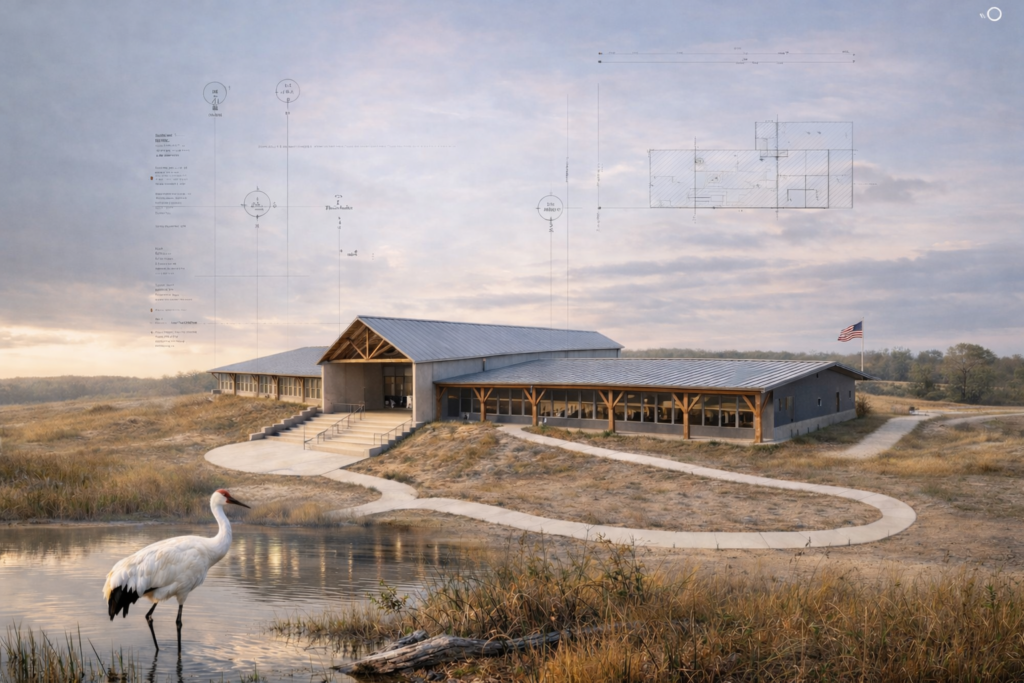
During migration season, when cranes fill the coastal skies, the architecture quietly amplifies the spectacle. The whooping crane is not just a seasonal visitor to Aransas — it defines the refuge. The building’s geometry draws directly from this iconic species.
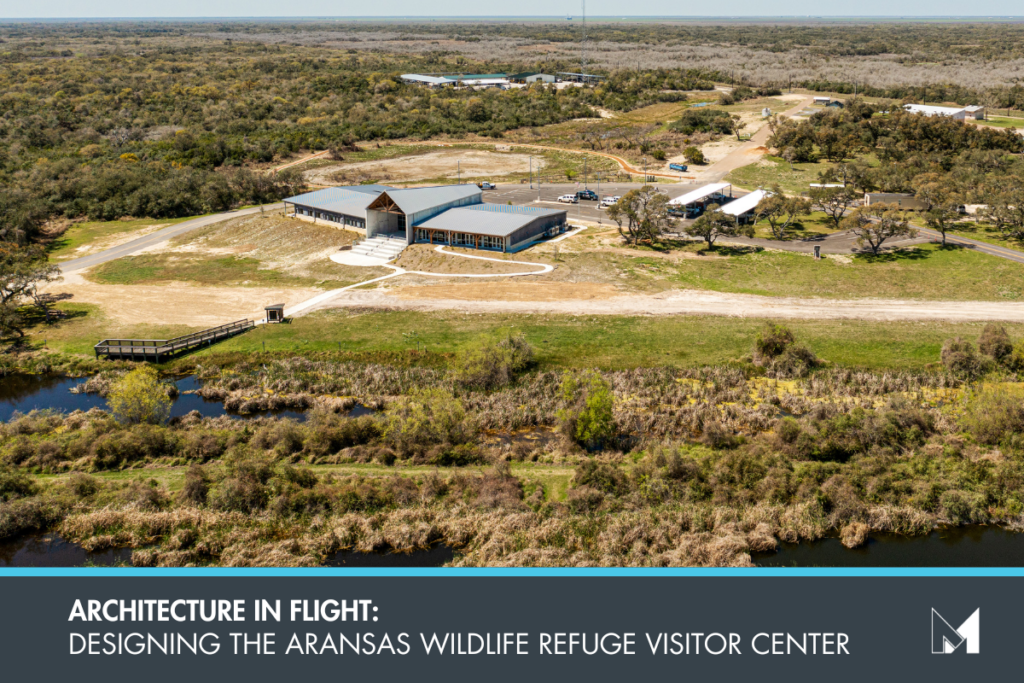
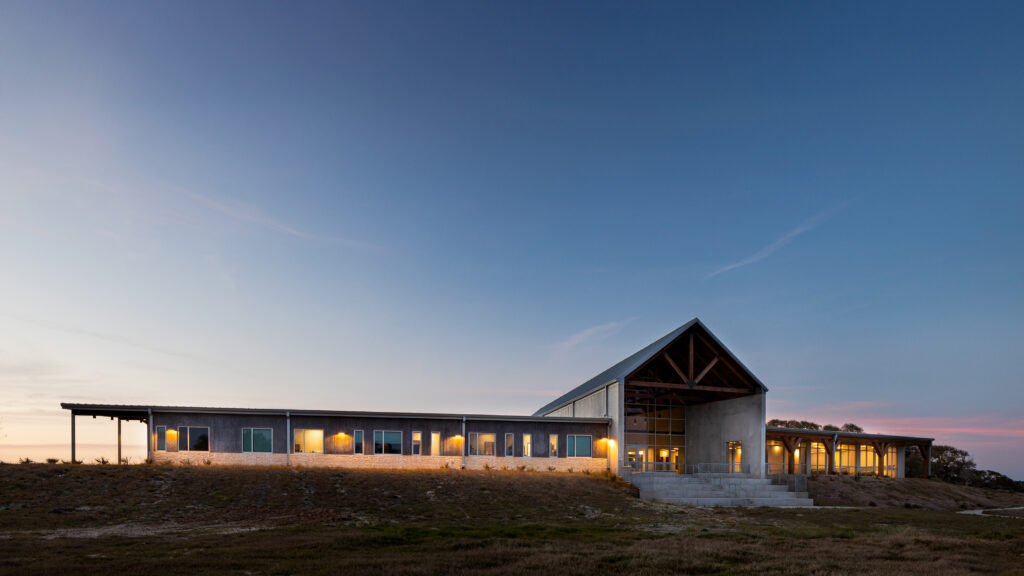
The visitor center is composed of two wings connected by a central corridor that opens toward the bay, subtly evoking the form of outstretched wings. The structure is carefully oriented around the site’s natural high point to frame expansive views of the water and marshlands — the very habitat where cranes forage and gather during winter.
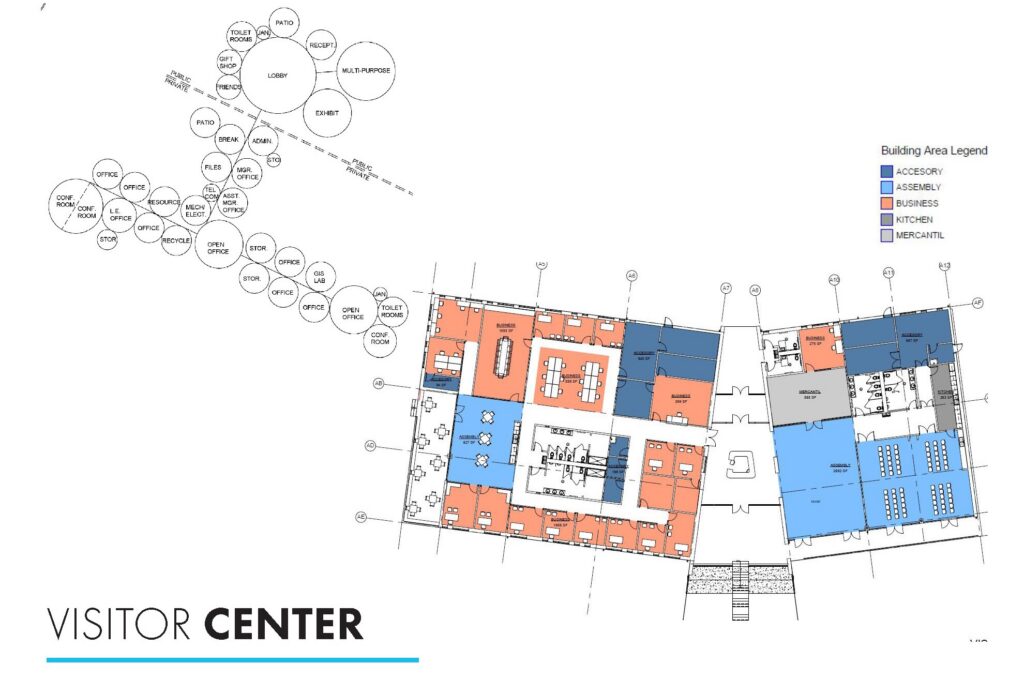
The landscape dictates visitor’s experience as they move through the building and their view aligns with the whooping cranes’ migratory path that reinforces a sense of connection between architecture and ecology. The building becomes both a shelter and a viewing instrument — a place to learn about migration while participating in it.
Designing for the Birds
Planning within a national wildlife refuge requires a different mindset. Protecting wildlife was not a secondary consideration — it was central to every decision.
Because birds can mistake reflective glass for open sky, the team worked closely with a glazing consultant to develop a bird-deterrent solution that would also meet strict hurricane-impact requirements. Multiple design exercises explored sloped glazing, broken-up panes, and specialized treatments to reduce collisions while maintaining expansive views.
The result balances durability and transparency: impact-rated glazing engineered for major storm events, carefully detailed to discourage bird strikes and protect migrating species. In a building inspired by the whooping crane, safeguarding birds was non-negotiable.

Resilient by Design
Building along the Texas coast demands preparation for extreme weather. The new complex includes five consolidated, hurricane-resistant buildings:
- Visitor Center
- Volunteer Building
- Bunkhouse
- Hunter’s Check Station
- Maintenance Facility

Precast concrete walls with integrated insulation provide strength, durability, and thermal performance. The color is integrated into the concrete itself, reducing long-term maintenance — an important strategy given the refuge’s remote location.
Solar panels supplement power supply and provide resilience during outages. Rainwater is collected in an 8,000-gallon underground cistern for irrigation, reducing strain on municipal systems. Passive strategies — including north-south orientation and controlled daylighting — enhance energy performance while maintaining comfort for visitors and staff. The project achieved LEED certification.
But sustainability here goes beyond checklists. The team was intentional about minimizing disturbance to the refuge. The new buildings were designed within the previously affected footprint. Damaged structures were removed, giving land back to the refuge. Parking and drives were carefully routed around existing trees, preserving the landscape that supports the cranes themselves.

A Place for Community and Conservation
Aransas is more than a habitat — it’s a gathering place.
The refuge attracts bird enthusiasts from around the world each winter, along with researchers, school groups, and families discovering the coast for the first time. A dedicated space within the visitor center supports Friends of Aransas, a nonprofit organization that partners with U.S. Fish & Wildlife and engaged throughout the design process.
Flexible meeting and classroom spaces allow the building to host lectures, educational programs, and community events — including those tied to migration season.
In many ways, the building serves as a bridge:
Between people and wildlife.
Between conservation and community.
Between resilience and beauty.

Celebrating Migration Season
As the cranes return this winter — tall, white silhouettes against the coastal sky — the visitor center once again becomes a front-row seat to a global journey.
The annual Whooping Crane Festival celebrates this migration, drawing attention to conservation efforts that have slowly helped the species recover from near extinction. Once reduced to fewer than 20 birds in the 1940s, the Aransas-Wood Buffalo population now numbers in the hundreds — a testament to decades of habitat protection and stewardship.
Architecture alone cannot save a species, but it can support the ecosystems, education, and community spaces that make conservation possible. At Aransas National Wildlife Refuge, the building itself participates in the story of migration — resilient against storms, protective of birds, and open to the expansive coastal landscape that defines this remarkable place.
As the cranes arrive each year, they return not only to a refuge — but to a visitor center designed in their honor.